Latest updates · 21 October 2026
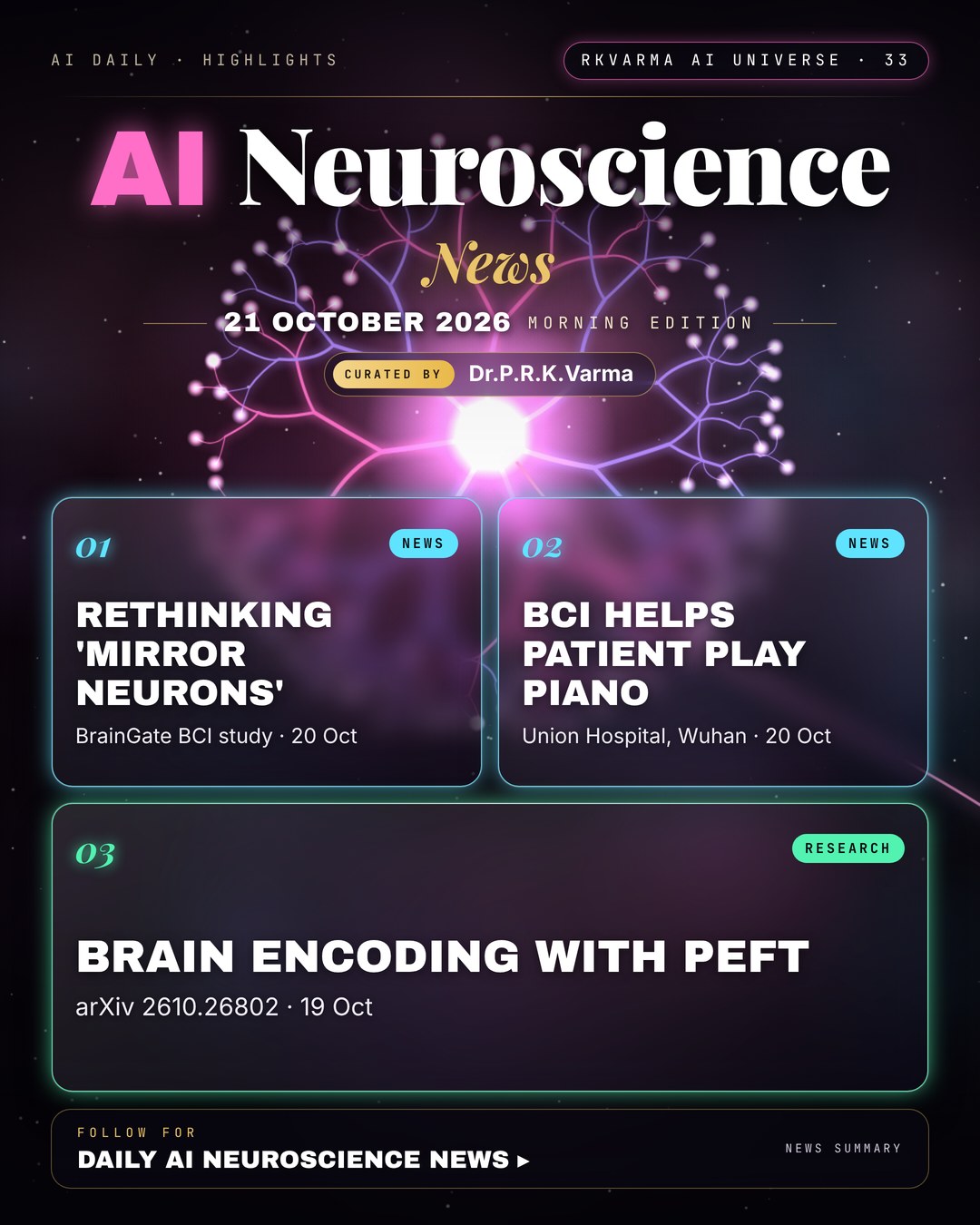
In the full issue →Brain-computer interfaces are revealing how the brain watches and helping patients move again: a BrainGate study questions the classic 'mirror neuron' picture, and a Wuhan system helped a woman with paralysis play the piano.
Research, industry & policy
- BrainGate study sheds light on neural activity during observation, Technology.org · 20 Oct 2026: Researchers from Brown University, Mass General Brigham and the VA found an ensemble of networks responding in a graded way to observed actions, rather than specialised mirror neurons.
- Brain-computer interface helps paralysed hand play a tune, China Daily · 20 Oct 2026: A 39-year-old woman with right-side paralysis played the piano again with a BCI rehabilitation system developed at Union Hospital in Wuhan.
Journals & preprints
- Scaling Parameter-Efficient Fine-Tuning for Brain Encoding, arXiv 2610.26802 · 19 Oct 2026: Brain encoding models aim to predict neural responses to stimuli.
Why it matters
Knowing how the brain responds to watching movement helps design BCIs that rely on visual feedback.